

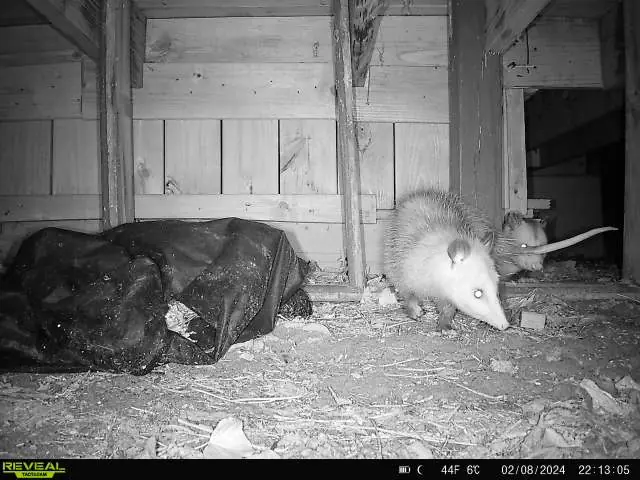
The Virginia opossum is North America’s only marsupial, and it lives in every corner of Maryland. Opossums are shy, slow and far less dangerous than their hissing suggests. But one that moves under your deck or into your garage brings droppings, fleas, raided trash and, sometimes, the smell of an animal that died where you can’t reach it.
Homeowners and businesses call us about:
- An opossum living under a deck, porch, stoop or shed
- Opossums in the crawl space, tearing insulation and ductwork
- An opossum in the garage eating pet food or bird seed
- Opossums in the attic, usually through a hole another animal started
- Knocked-over trash cans and raided compost
- Lost chickens, eggs, garden fruit and vegetables
- Droppings on decks, patios and garden paths
- Run-ins with dogs and cats at night
- A dead-animal smell from under the house or deck
Keep reading to learn how opossums live, why they move in, and exactly how we solve each of these problems. Or skip ahead and call 410-994-8881 to book an inspection.
Opossums and Their Look-Alikes in Maryland
Maryland has just one opossum, the Virginia opossum, and it has no close relatives here. It is the only native marsupial in the United States. What people mix up is which animal is living under the deck.
| Species | Size and look | When active | Typical problem |
|---|---|---|---|
| Virginia opossum | 4 to 13 lb, body 15 to 20 inches plus a 9 to 20 inch bare, scaly tail. Gray-white fur, white face, black ears, pink nose | Night | Under decks and sheds, garages, crawl spaces, trash and pet food |
| Raccoon | 10 to 35 lb. Black mask, ringed bushy tail | Mostly night; sometimes by day | Attics, chimneys, roof damage, latrines |
| Striped skunk | House-cat size, up to 8 lb. Black with white stripes | Night | Under decks and porches, lawn digging, spraying |
| Groundhog | 4 to 14 lb, about 16 to 26 inches long including a short, bushy tail. Stocky, short legs, grizzled brown fur | Day, mostly morning and late afternoon; hibernates in winter | Burrows under decks, sheds, slabs and foundations; gardens |
The long, nearly hairless tail is the giveaway. A young opossum is sometimes mistaken for a very large rat, but look for the white face, black ears and pink nose. If you smell a sharp, sulfur odor around the den, it’s a skunk, not an opossum.
Opossum Biology and Behavior
Meet the Virginia opossum
The Virginia opossum (Didelphis virginiana) is a survivor. Opossums have been around in some form for at least 70 million years, and they are common across Maryland, from city alleys to farm fields.
- Size: Adults weigh 4 to 13 pounds, with a body 15 to 20 inches long and a tail of 9 to 20 inches.
- Look: Grizzled gray-white fur, a white face, black ears and a pink nose. The tail is scaly and nearly hairless.
- Teeth: About 50, more than most other mammals. A cornered opossum bares them, hisses and growls. It’s mostly a bluff, but it can bite.
- Lifespan: Short. Most live only 1 to 3 years in the wild.
- Daily schedule: Opossums are primarily nocturnal and roam at night looking for food.
- Diet: Almost anything: insects, worms, small animals, fruit, nuts and carrion. Around homes, that means pet food, trash, compost, bird seed and fallen fruit.
Dens: why the space under your deck looks so good to an opossum
Opossums don’t dig their own burrows. They borrow shelter wherever they find it: hollow trees, brush piles, other animals’ burrows and the space under porches. Buildings, woodpiles and junk piles work too.
That’s why opossums so often turn up under decks, sheds and stoops, in crawl spaces and in garages. An existing gap, a hole a groundhog dug, or a garage door left open is all it takes. In attics, opossums usually use an opening another animal started.
Opossums don’t hibernate. In harsh cold they hole up in a sheltered den, and frostbitten ear and tail tips are common. A warm crawl space or garage is a big draw in winter.
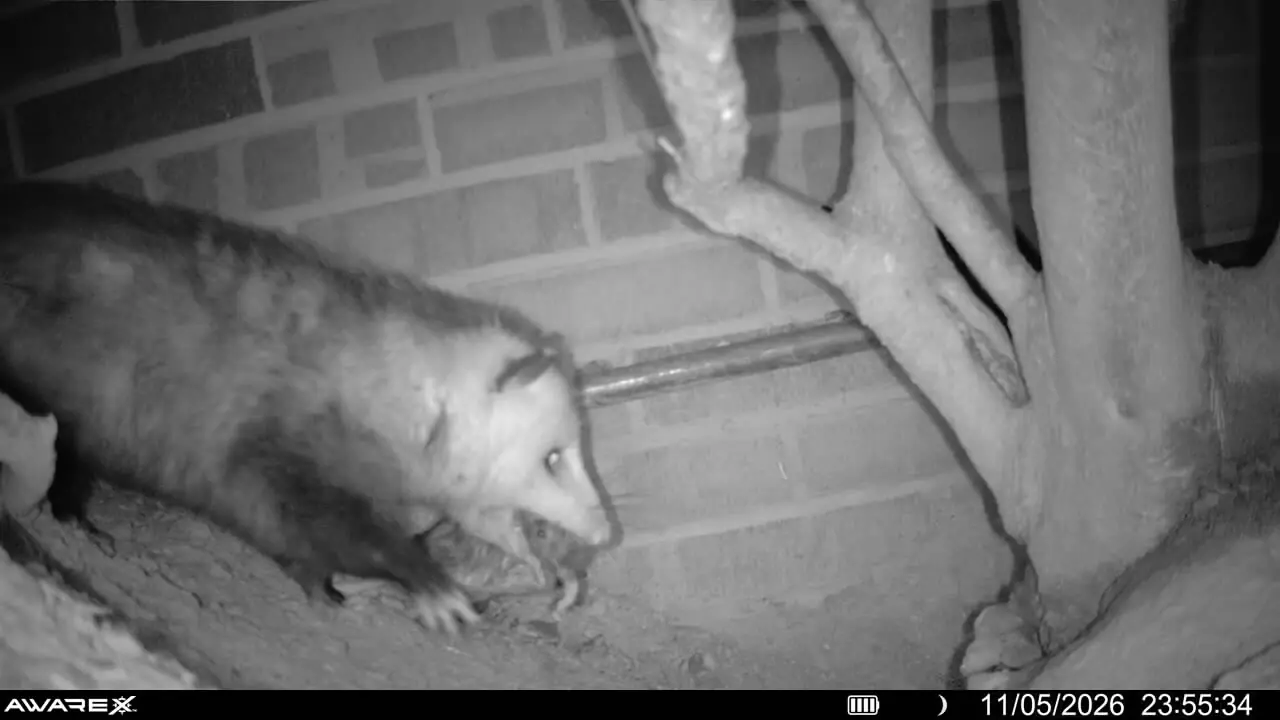
An opossum carries a rat for dinner into a groundhog den.
“Playing possum”
When cornered, an opossum may go limp and catatonic, drool, and release a foul-smelling fluid from its anal glands. Predators often lose interest. More often, though, an opossum simply tries to escape or stands its ground and hisses. An opossum lying still in your yard may be very much alive, so leave it alone and give it time to leave.
Pouch joeys and a fast breeding cycle
Opossums breed from January to July in Maryland. The young are born just 12 to 13 days after breeding and live and nurse in the female’s pouch for about two months. A litter can start with up to 20 tiny young, but on average about 7 survive to leave the pouch. After the pouch, they ride on the female’s back, and they’re on their own at 3 to 4 months. Most females have two litters a year, and some have three.
The Good Side of Opossums
Opossums get a lot of love online, and some of it is earned. Some of it isn’t. Here’s what the research supports.
- They clean up. Opossums are scavengers that eat carrion, insects, worms and fallen fruit. We consider them more beneficial than harmful because they eat insects and mice.
- They rarely carry rabies. Maryland DNR describes opossums as highly resistant to rabies. Of the 226 lab-confirmed rabid animals in Maryland in 2025, none was an opossum. Rare isn’t never, so still don’t handle one.
- They don’t dig up yards. Opossums don’t dig burrows or tear up lawns the way skunks and raccoons do.
- The “5,000 ticks” claim doesn’t hold up. A popular myth is that an opossum eats about 5,000 ticks a season. That number was extrapolated from a small 2009 lab study. When researchers later examined the stomachs of wild opossums, they found no ticks at all, and no published diet study has reported ticks in opossum diets. Opossums are helpful neighbors, but they aren’t tick control.
The goal of good opossum control is balance: opossums in the woods and hedgerows, not under your deck or in your garage.
Signs You Have Opossums
Opossums are quiet and nocturnal, so many homeowners find the signs before the animal. Call us if you notice any of these:
- An opossum seen at night near a deck, shed, stoop or crawl space vent
- A gap or hole under a deck, porch or shed
- Pet food or bird seed disappearing overnight in the garage or on the porch
- Trash cans tipped over, compost bins raided
- Droppings on decks, patios or garden paths
- Torn crawl space insulation or vapor barrier
- Thumping or shuffling noises under the floor at night
- Hand-like tracks with a thumb-like toe on the hind foot, in mud or dust
- Missing eggs or chickens, or bitten fruit and vegetables in the garden
- A musky or dead-animal smell from under the house, deck or shed
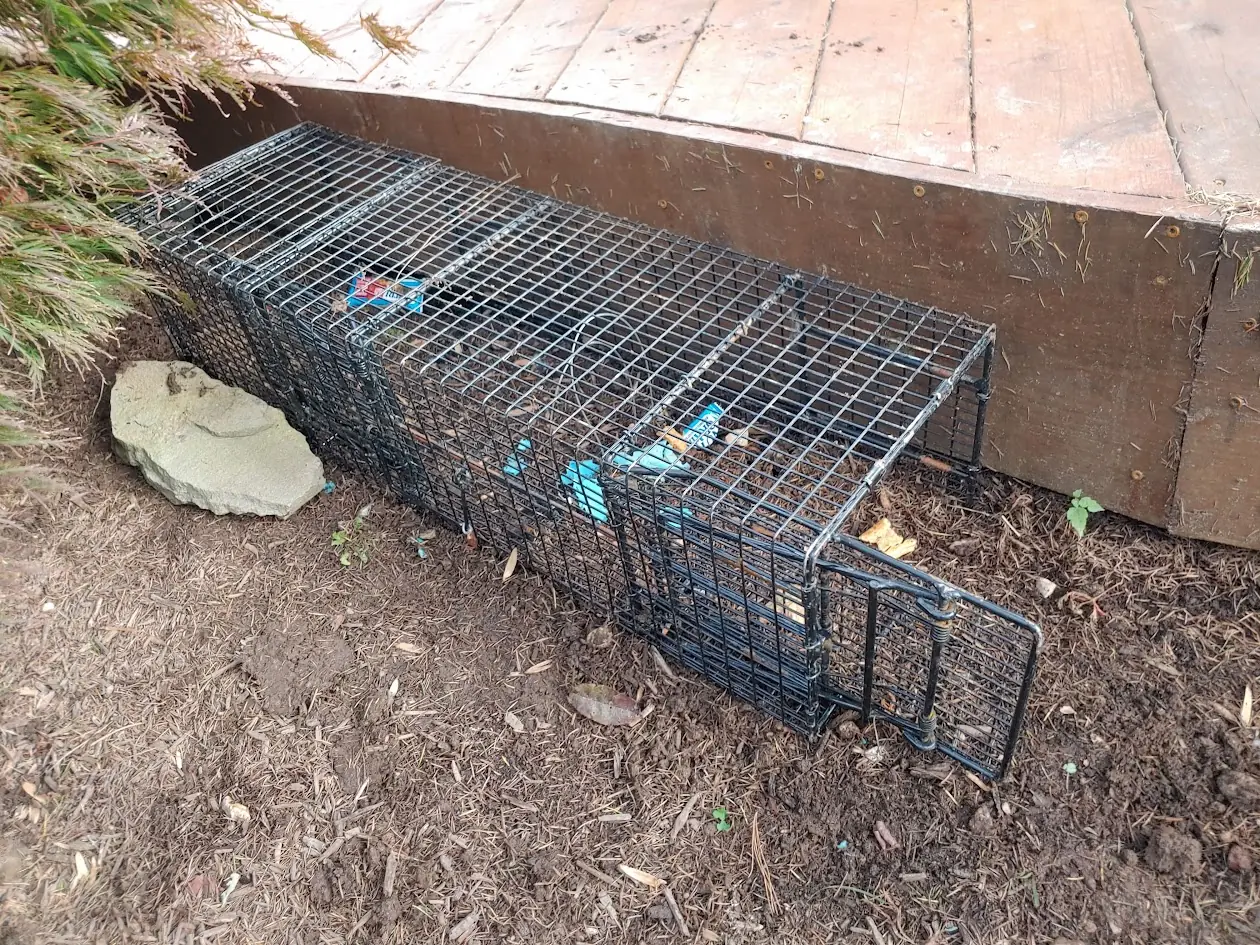
We set a cage trap right at the opening where an opossum was getting under this deck.
Opossum Problems, Hazards and Damage, and How We Fix Each One
Opossums are less destructive than raccoons or squirrels, but the same problems come up again and again. Here is what each one means for your property and exactly how our team handles it.
1. Opossums under decks, porches, stoops and sheds
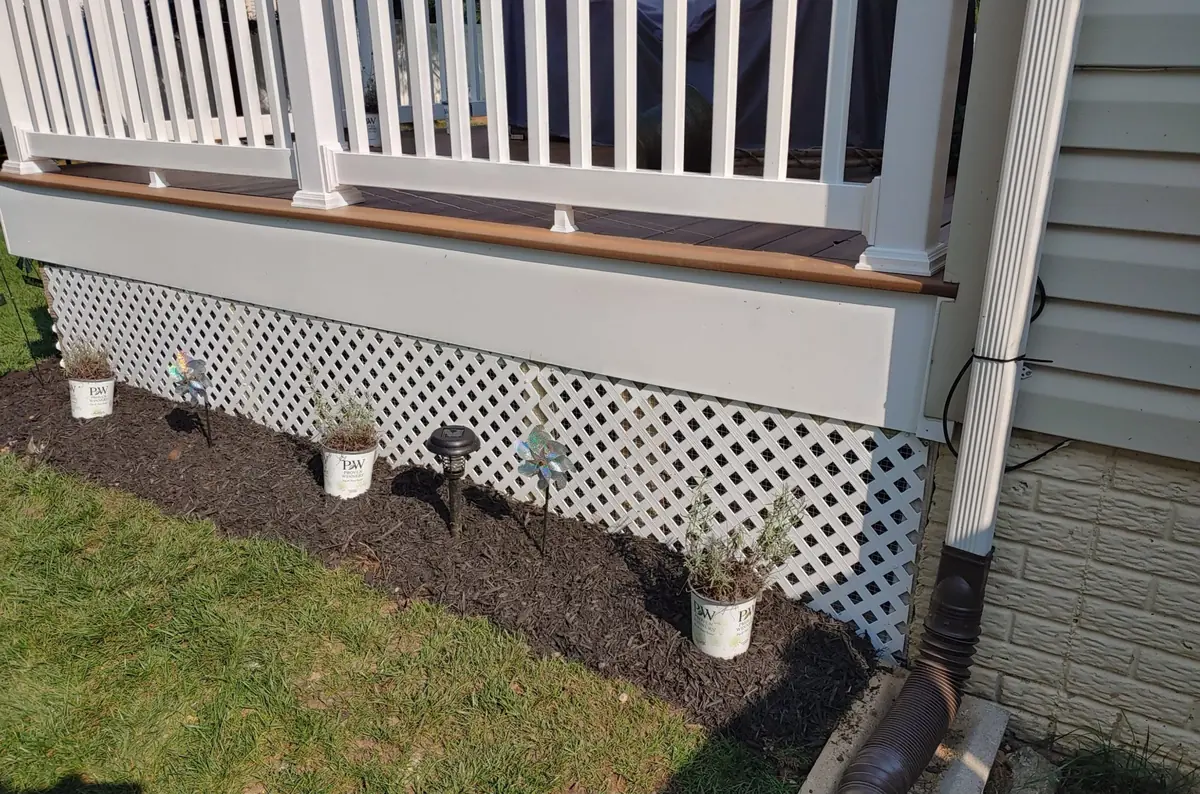
The hazard: This is the most common opossum problem around Maryland homes. The space under a deck or shed is dry, dark and close to food. Opossums leave droppings and odor there, bring fleas and other parasites close to the house, and a female may raise a litter there. If an opossum dies under the structure, you’ll smell it long before you can reach it.
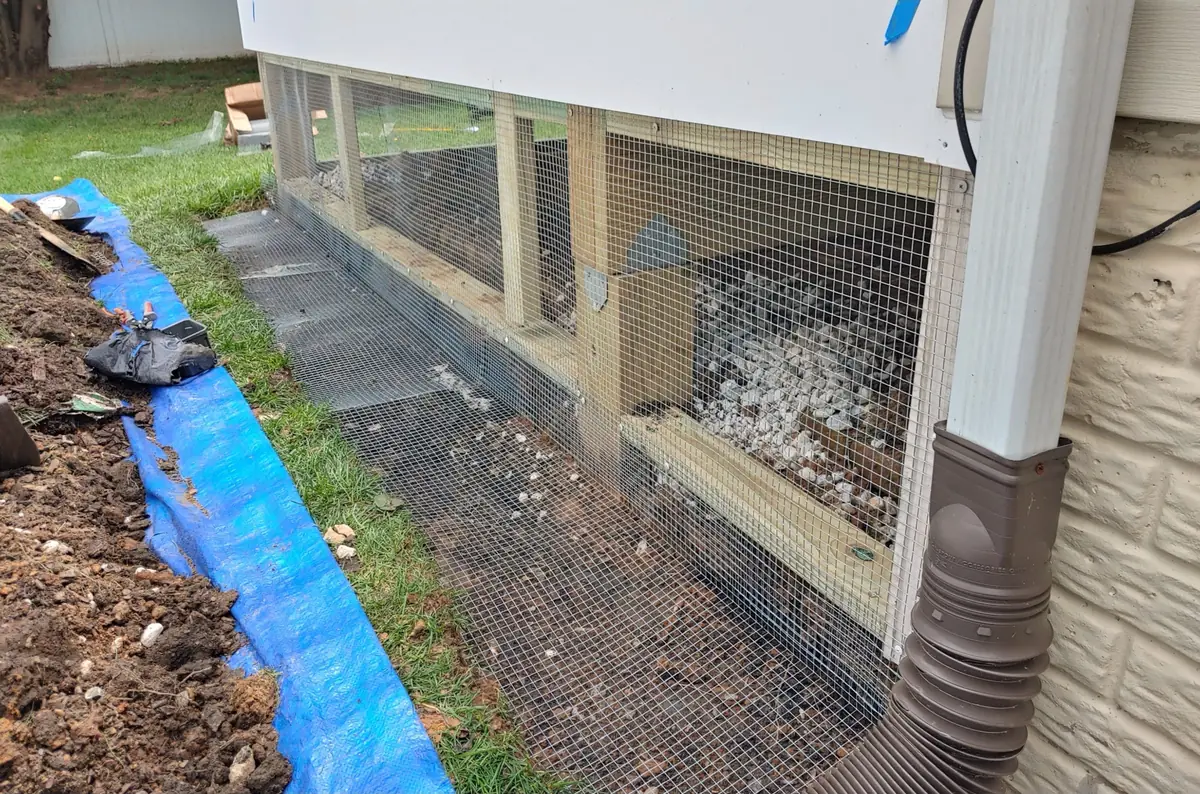
How we fix it: We remove the opossum, check for young, and then screen the perimeter of the deck, porch or shed with sturdy wire mesh buried below grade so nothing can slip back under.
2. Opossums in crawl spaces
The hazard: Opossums get into crawl spaces through loose access doors, foundation vents and gaps around pipes. Once inside, they can tear insulation and leave droppings where you can’t easily clean them. Torn vapor barrier and ductwork insulation let moisture and odors move into the house.
How we fix it: We remove the opossum, then secure the access door, foundation vents and utility gaps with heavy-gauge screening and metal. When insulation or vapor barrier is soiled or torn, we document it and recommend the right repair.
3. Opossums in garages
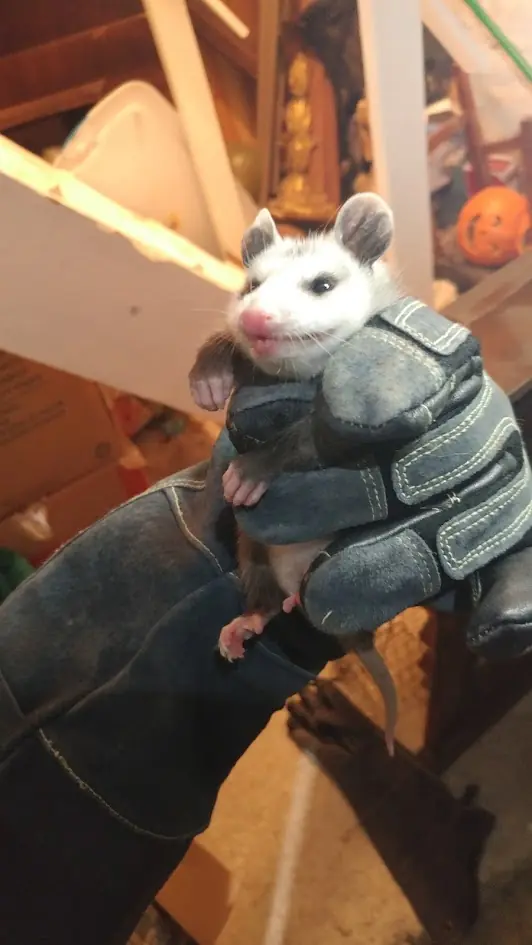
The hazard: An opossum will walk right into an open garage after pet food, bird seed or trash, then hide behind storage and stay. They make a mess of feed bags and trash, and a frightened opossum hisses and may bite when someone reaches for it.
How we fix it: Open the garage door, turn off the lights, keep pets inside and give the opossum a quiet hour to leave on its own after dark. If it won’t leave, or it has young, call 410-994-8881 and we’ll remove it. Then we seal gaps under and around garage doors and move the attractants.
4. Opossums in attics
The hazard: Opossums aren’t natural roof climbers the way raccoons and squirrels are, but they do climb, and they will use an existing hole. An attic opossum soils insulation and can get trapped and die there.
How we fix it: We remove the opossum and seal every entry point, especially damaged soffits, gable vents and roof-to-wall gaps. When insulation is soiled, our damage repair service cleans the attic and replaces it.
5. Trash, pet food, compost and bird seed
The hazard: Opossums scatter garbage and eat pet food. Steady food is the main reason an opossum stays on a property instead of passing through.
How we fix it: Usually a habitat fix: locking metal or heavy plastic cans, pet food brought in at night, and feed stored in sealed bins.
6. Chickens, eggs and gardens
The hazard: Opossums raid chicken coops and eat garden crops such as vegetables, apples and strawberries. Backyard flocks lose eggs and sometimes birds.
How we fix it: We remove the opossums doing the damage, and we show you how to tighten up the coop: hardware cloth instead of chicken wire, secure doors, and birds locked in at night. For gardens, fencing and picking up fallen fruit go a long way.
7. Fleas, ticks, parasites and disease
The hazard: Opossums can carry fleas, ticks, roundworms and other common parasites, plus mites and lice. They can also carry diseases such as leptospirosis. When an opossum leaves or is removed, its parasites can move to pets. Rabies is rare in opossums, but no wild animal should be handled.
How we fix it: We remove nesting material where we can reach it, and, when needed, treat for fleas and other parasites through our pest control services. Keep pets on vet-recommended flea and tick prevention, and wear gloves around droppings.
8. A risk to horses (EPM)
The hazard: Opossums can carry Sarcocystis neurona, the parasite behind equine protozoal myeloencephalitis (EPM), a disease of the horse nervous system. It spreads when opossum droppings contaminate feed or water. Most opossums probably don’t shed the parasite, but it’s a real concern on Maryland horse farms.
How we fix it: For barns and stables, we remove resident opossums and help you animal-proof feed rooms, feed bins and water sources. Talk to your veterinarian about EPM risk and prevention.
9. Run-ins with dogs and cats
The hazard: Opossums usually avoid fights, but a cornered opossum will hiss, gape and bite, and it can inflict serious bites on cats and dogs.
How we fix it: We remove the opossum and close off the den that keeps it near your pets. Bring pets and their food in at night until the job is done.
10. Dead opossums and odor
The hazard: Opossums live short lives and den in tight spaces, so a dead one can end up under a deck, shed or house, or in a crawl space or wall. The smell can be overwhelming, and it draws flies.
How we fix it: We locate and remove the carcass, clean and deodorize the area, and seal the space so another animal doesn’t move in.
Something living under your deck or in the garage? The sooner it’s out and screened, the less there is to clean up. Book an Opossum Inspection or call 410-994-8881.
Why Every Opossum Job Starts With an Inspection
The opossum you saw by the deck may not be the only one, and it may not be the animal causing the problem. Skunks, raccoons, groundhogs and rats use the same spaces. Trapping one opossum without screening the den just makes room for the next animal.
An inspection also tells us whether young are present and where every opening is, so the job is done right.
During an opossum inspection, our technicians:
- Walk the full perimeter of the house, deck, porch, stoops and sheds, looking for gaps, dens and travel paths.
- Check crawl space doors, foundation vents and utility openings, and inspect the crawl space if there’s access.
- Look for droppings, tracks, hair and nesting material to confirm which animal is living there.
- Check the garage, attic and roofline if there are signs of activity there.
- Check for a female with young before choosing a removal method.
- Note attractants such as pet food, bird seed, trash, compost, chickens and fallen fruit.
- Photograph everything and give you a written plan with clear pricing for removal, screening and any cleanup.
Those photos and notes also help if you file a homeowner’s insurance claim.
A wildlife inspection is $149, and the fee is credited toward your job if you move forward.
Opossum Control Methods: What Works and What Doesn’t
Professional wildlife control uses six categories of management. Here is how each one applies to opossums, and how we use them.
1. Habitat modification
Changing the property so it’s less attractive to opossums. Verdict for opossums: the most important long-term step, because food is usually what keeps them around.
- Bring pet food in at night, and store pet food, bird seed and feed in metal or heavy plastic bins with tight lids.
- Use latching trash cans and keep lids closed.
- Pick up fallen fruit, and protect poultry and gardens with secure housing or fencing.
- Clear brush, woodpiles and rock piles near the house.
- Keep the yard well lit at night. Opossums avoid bright areas.
Our role: We point out every attractant during the inspection and tell you which changes matter most.
2. Exclusion
Physically sealing opossums out. Verdict for opossums: the permanent fix, and the core of our service.
- We screen the perimeter of decks, porches and sheds with sturdy wire mesh that runs below grade and bends outward underground, so animals that try to dig at the edge hit wire.
- We secure crawl space doors, foundation vents and utility gaps with heavy-gauge screening.
- For attics, we seal the roofline the same way we do for raccoons and squirrels. Learn more about our whole-home wildlife exclusion.
Why this is a job for a licensed professional: Maryland’s wildlife laws protect the dens of furbearers like opossums. That means homeowners can’t legally destroy, block or dig out an opossum den themselves. Licensed wildlife damage control operators like us work under a Maryland DNR permit that lets us do this work legally. Our technicians make sure no opossum or its young is trapped inside, do the work humanely and at the right time of year.
3. Repellents and deterrents
Products meant to make an area unpleasant to opossums. Verdict for opossums: they don’t work.
- Chemical repellents: None are known to be effective for opossums.
- Mothballs (naphthalene): Ineffective, and the vapor is harmful to people. Never put them under a deck or in a crawl space.
- Lights: Good lighting can make a yard less inviting, but it won’t move an opossum that has already settled into a den.
Our role: We’ll tell you plainly when a product is a waste of money. For opossums, it almost always is.
4. Population reduction: trapping and removal
Removing the opossums that are causing problems. Verdict for opossums: often needed to get the animal out, but never a fix without exclusion.
- Landowner permits: Homeowners may only trap wildlife outside regulated seasons when the animal is actively damaging property or threatening health and safety, and they need to obtain a permit from Maryland DNR first.
- Because we hold a Maryland DNR wildlife damage control permit, we can remove nuisance opossums outside the regular trapping seasons.
- What happens after capture: Opossums are not on Maryland’s rabies-vector list, which means that they may be released if permission is provided by the owner of the release site. Moving an opossum to someone else’s land or a park without permission isn’t allowed.
- Methods: Cage traps are effective for opossums. We place them where the opossum travels, check them on a set schedule, and release non-target animals.
We follow Maryland DNR rules and our own humane standards for every animal we capture.
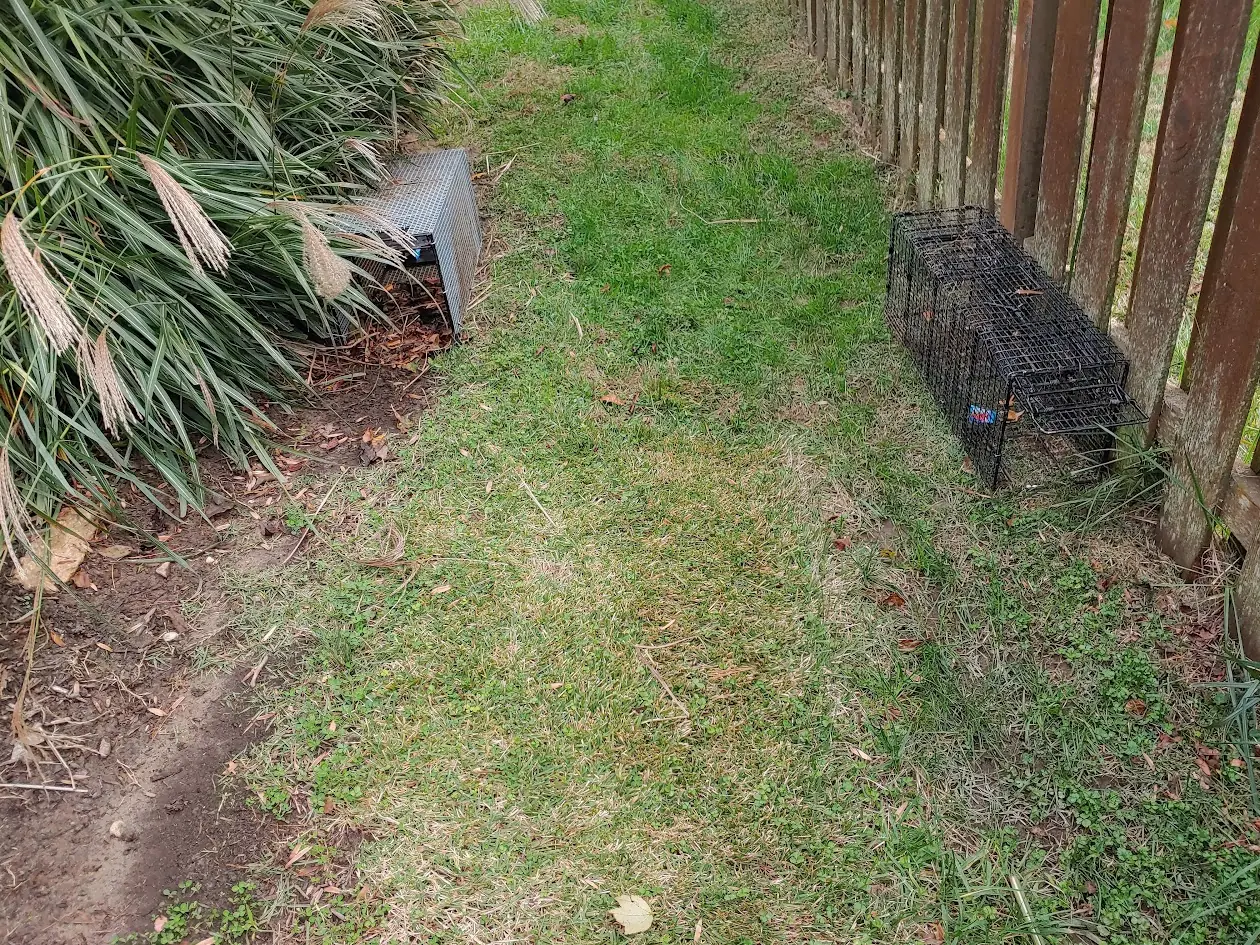
Traps set along a fence line, on the path an opossum was traveling.
5. Chemical control
Poisons and toxicants. Verdict for opossums: not an option. No toxicants are registered for opossum control, and rodent poison baits should not be used on opossums. Poisoned animals die under decks and in crawl spaces, and the poison can kill pets and other wildlife. Maryland Wildlife Solutions does not use poison on opossums.
6. Biological control
Using predators or diseases to control a population. Verdict for opossums: not practical. Opossums have predators, but no predator keeps them out from under a deck. A dog is not a solution, and a cornered opossum can badly bite a dog or cat.
The bottom line
The combination that works is inspection, removal, excluding the den and removing the food that drew the opossum in. That’s what our opossum program delivers.
DIY Opossum Prevention: What You Can Do Today
Most opossum problems start with food and an open space to hide. You can fix a lot of both yourself:
Around the house
- Keep the garage door closed at night, and seal gaps under the door.
- Make sure crawl space doors close tightly and foundation vents are screened.
- Walk around your deck, porch and shed and look for gaps at ground level. Block them before animals move in.
- Keep the yard well lit near the house.
Food and trash
- Feed pets indoors, or bring bowls in before dark.
- Store pet food, bird seed and chicken feed in metal or heavy plastic bins with tight lids.
- Use latching trash cans, and secure lids with bungee cords if needed.
- Pick up fallen fruit and spilled bird seed.
Chickens, gardens and barns
- Lock chickens in a coop every night.
- Fence gardens and berry patches during harvest.
- On horse farms, keep feed in sealed bins and protect water troughs from droppings.
What not to do
- Don’t block an opening until you’re sure no opossum or young are inside.
- Don’t dig out, block, collapse or destroy an opossum den yourself. Maryland law protects them, and only licensed operators can do this work. Call us first.
- Don’t use mothballs, ammonia or poison.
- Don’t trap without a Maryland DNR permit, and don’t move an opossum onto someone else’s land.
- Don’t pick up an opossum that is “playing dead.” Leave it alone and keep pets inside.
- Don’t try to raise orphaned young opossums yourself. Contact a licensed wildlife rehabilitator.
Frequently Asked Questions About Opossums
Do opossums carry rabies?
Rarely. Maryland DNR describes opossums as highly resistant to rabies, and none of Maryland’s 226 lab-confirmed rabid animals in 2025 was an opossum. They can still bite and carry parasites, so don’t handle one.
Do opossums really eat 5,000 ticks a season?
No. That figure came from a small 2009 lab study and some extrapolation. When researchers examined the stomachs of wild opossums, they found no ticks. Opossums can actually carry ticks.
There’s an opossum lying still in my yard. Is it dead?
It may be “playing possum.” A frightened opossum can go limp, drool and give off a bad smell. Keep pets and children away and check again later. If it’s still there, or it’s clearly dead, call us.
Will the opossum leave on its own?
Sometimes. But if there’s food nearby and a dry space under your deck, it may stay, and another will follow. Screening the space is what ends the problem.
Do opossums dig under decks and sheds?
They don’t dig their own burrows. They move into gaps and holes that already exist, often ones dug by skunks or groundhogs.
I found a young opossum. What should I do?
Don’t take it inside or try to feed it. If it looks injured, is very small or is alone for a long time, contact a licensed wildlife rehabilitator.
Is it legal to trap an opossum myself in Maryland?
Only with a landowner permit from Maryland DNR, and only when the opossum is actively damaging property or threatening health and safety.
Do you relocate opossums?
Usually not. Relocated animals often die in unfamiliar territory, and moving them can spread disease. When an animal can’t be released, it is humanely euthanized as Maryland rules allow. That’s why our focus is sealing your home so very few animals are ever caught.
Are opossums dangerous to my dog or cat?
Opossums usually avoid fights, but a cornered one will hiss and can bite hard. Keep pets in at night until the opossum is gone.
Do you guarantee your work?
Yes. Every exclusion job comes with our one-year general warranty. Choose our full home exclusion package and you get our Full Home Exclusion warranty, which covers any wildlife or rodent getting into your home through any opening, renewable every year.
Get Opossums Out and Keep Them Out
Maryland Wildlife Solutions is a licensed and insured wildlife control company based in Gambrills. Our owner is an NWCOA Certified Master Instructor and the 2020 NWCOA Educator of the Year, and he trains wildlife professionals across the country. He serves on the NWCOA Training Committee and is a past Director at Large on the NWCOA Board of Directors. We’re licensed in Maryland, Virginia and Washington DC. We are also a certified Maryland Small Business Enterprise (SBE). Our team holds the NWCOA Zoonotic Disease Professional certification. We remove opossums humanely and screen your deck, shed and crawl space so the next one can’t move in.
Call: 410-994-8881 | Email: info@mdwild.com
Serving homes and businesses across Maryland, Washington DC and Virginia. See our full service area.